
The Formula for Forgiveness
Matthew 6:
14 "For if you forgive others their sins, your heavenly Father will also forgive you.
15 But if you do not forgive others, your Father will not forgive you your sins.
(NET Bible®)
Forgiveness of sins is conditional. If you have been living a sin-free life, this is no big deal. I, for one, have not. I have quite a few sins on the record to offset. I don’t want an unforgiving government acting on my behalf, acting mercilessly even for offenses which wouldn’t warrant prosecution even before the new dispensation. Such a sentiment was part of my impulse to become a libertarian many years ago.
For those not well versed in the Bible, the passage above follows the Lord’s Prayer, which should be familiar to anyone who was ever a Christian:
Matthew 6:
9 So pray this way:
Our Father in heaven, may your name be honored,
10 may your kingdom come,
may your will be done on earth as it is in heaven.
11 Give us today our daily bread,
12 and forgive us our debts, as we ourselves have forgiven our debtors.
13 And do not lead us into temptation, but deliver us from the evil one.
(NET Bible®)
You are more likely familiar with a different translation. That’s fine. Regardless, note verse 12: it requests conditional forgiveness! If you have been reciting this prayer in any translation, that’s what you have been asking for. It might pay to honor your side of the bargain.
Do note that verse 12 gets some quite different seeming translations. The King James Bible uses “trespasses” instead of debts. The ambiguity is important, and part of my motivation for moving away from pure libertarianism to the ideas found throughout this site.
Forgiveness as Mercy
Throughout this series I treat forgiveness and mercy as virtually interchangeable. The dictionary definition of mercy includes both clemency and charity. Both are implied in the Lord’s Prayer. To see this, we need to think about the meaning of debts under the Law.
Luke 12:
57 "And why don't you judge for yourselves what is right?
58 As you are going with your accuser before the magistrate, make an effort to settle with him on the way, so that he will not drag you before the judge, and the judge hand you over to the officer, and the officer throw you into prison.
59 I tell you, you will never get out of there until you have paid the very last cent!"
(NET Bible®)
Wealthy Israelites were expected to give zero-interest loans to their neighbors in need [Deuteronomy 15:7-10]. However, this requirement was just a loan. If the neighbor did not pay it back, then he was to become a bondservant to his creditor until the year of release (every 7 years). To forgive a debt is to forgo either the repayment of the loan or this time of service. Forgiving a debt under this circumstance is the equivalent of the modern idea of charity. It is giving outright to those in need.
Forgiveness of debts also refers to clemency. Under the Law a thief was required to pay back double the amount stolen (or more for certain livestock). If the thief could not pay, then the thief became a bondservant just like any other debtor. In other words, to forgive a thief is to forgive a debtor. The only difference is that an ordinary debtor who borrows $1000 owes $1000 under the Law, while a thief who steals $1000 owes $2000. A debt is a trespass.
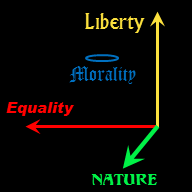
So, when Jesus spoke of forgiving debts, he referred to both forgiving criminals and to giving money to the poor. These are both very liberal mandates. (I’ll get to where modern liberalism diverges from the Christian Way in a later chapter.)
What of Grace?
All this talk of conditional forgiveness may seem at odds with the Parable of the Vineyard or St. Paul’s lengthy dissertations on grace. It need not be.
The talk of grace could be about a second chance, to be “dead unto the law” upon baptism. For a pagan who has a history of practicing magic, having sex with ritual prostitutes, and other serious sins, such a second chance is crucial. Forgiving enough debts/trespasses to make up for such a huge backlog can be virtually impossible. One might as well remain a pagan.
But one does not get baptized on a daily basis. Does the one baptism provide ongoing washing of sins?
The ancient Christians thought otherwise. Many sought to be sin free after conversion, expecting the End to come soon enough. When the End didn’t happen, many resorted to all sorts of unpleasant penances. (See Paul Johnson’s A History of Christianity.)
I’d rather follow Jesus’ formula for forgiveness. It’s cheaper, but not entirely free as we’ll see in the next chapter.
Matthew 18:
23 "For this reason, the kingdom of heaven is like a king who wanted to settle accounts with his slaves.
24 As he began settling his accounts, a man who owed ten thousand talents was brought to him.
25 Because he was not able to repay it, the lord ordered him to be sold, along with his wife, children, and whatever he possessed, and repayment to be made.
26 Then the slave threw himself to the ground before him, saying, 'Be patient with me, and I will repay you everything.'
27 The lord had compassion on that slave and released him, and forgave him the debt.
28 After he went out, that same slave found one of his fellow slaves who owed him one hundred silver coins. So he grabbed him by the throat and started to choke him, saying, 'Pay back what you owe me!'
29 Then his fellow slave threw himself down and begged him, 'Be patient with me, and I will repay you.'
30 But he refused. Instead, he went out and threw him in prison until he repaid the debt.
31 When his fellow slaves saw what had happened, they were very upset and went and told their lord everything that had taken place.
32 Then his lord called the first slave and said to him, 'Evil slave! I forgave you all that debt because you begged me!
33 Should you not have shown mercy to your fellow slave, just as I showed it to you?'
34 And in anger his lord turned him over to the prison guards to torture him until he repaid all he owed.
35 So also my heavenly Father will do to you, if each of you does not forgive your brother from your heart."
(NET Bible®)