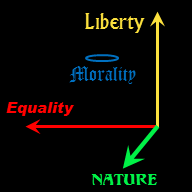

On Enforcing Morality
Should government enforce personal morality? Should we invoke the might of the state to make people better? Many liberals and libertarians would shout “No!” and cite the Constitution or other rights-based arguments to end the discussion.
Not here. At Holistic Politics we consider all political values. Liberty does not trump morality. We always play no trump, and the moralists hold some face cards. Just off the top of my head I can come up with some powerful reasons for morals enforcement without resorting to any religious creed or ascetic philosophy. The hardcore social conservatives in the audience can likely do even better. Consider:
- Pornography and promiscuity can be fun, but illegitimacy and broken homes cause great misery. If jailing Hugh Hefner and patrolling the Internet for naughty pictures would keep families together, then doing so would be a large increase in net happiness.
- Recreational drugs and alcohol properly used can be great fun and can even build a more cohesive society. (Compare with television!) Drug abuse, however, produces more suffering than pleasure, especially when we consider those close to the abuser of drugs or alcohol.
- We can say the same for gambling. While Bill Bennett may be able to pleasurably gamble within his means, many others wreck their lives and those of their family while seeking a change in luck.
So, ceteris paribus, the case for some morals legislation is strong.
Ah, I can see many libertarians in the audience are wincing at the utilitarian nature of the above arguments. To legislate on utilitarian arguments alone is a dangerous practice indeed. Still, the social conservatives are entitled to a neener-dance at this point. You libertarians are using moral arguments against legislating morality. But to dismiss utilitarian arguments out of hand while lawmaking while adhering to moral arguments is to legislate morality. Libertarians legislating morality. Ah, the irony.
Moral conservatives legislate morality as well, of course. They just apply a broader set of moral axioms than just the Zero Aggression Principle. For example, the Old Testament endorses aggression (and how!) to deal with certain types of immorality. The only first principles counter argument must come from studying the Bible itself (which I have done here, here, here, here, and here). But suppose we did limit our moral axioms for consideration to that of minimizing aggression (theft, fraud, initiated violence), moral conservatives would still have some powerful arguments:
- That first cigarette or crack pipe may be a free choice rational decision. Subsequent doses are another story. One can argue that drug pushing is coercion, a form of enslavement.
- Zero government is not zero aggression. Without government, we might instead deal with local warlords or foreign conquerors. The libertarian argument for some government is that government done right minimizes overall aggression and coercion.
- Vice can lead to real crimes (as defined by libertarians). Where vice law enforcement is the most efficient way to reduce crime, it is justifiable on libertarian grounds.
- Children are not free agents. We all start life under (hopefully benevolent) coercion. When vice leads parents and guardians to mistreat children, vice law enforcement is justifiable on libertarian grounds.
- Abortion is murder, or something suspiciously similar. If cracking down on sexual shenanigans cuts down on abortion, then we just might have a net reduction in force initiation.
So once again, ceteris paribus, government should most definitely be in the business of enforcing morality.
The case against enforcing morality becomes considerably stronger once we drop the ceteris paribus qualifier. All things are not equal. We cannot legislate away bad behavior directly; we can only legislate laws which we hope can lead to better behavior. And as we know from bitter experience, such laws often fail spectacularly. Liberty may not trump morality, but it does take priority over futile symbolic gestures. The real question is: Can government enforce morality?
And the glib answer is: No. Drug use proceeds apace despite the War on Drugs. We even have illegal drug use in prisons! Adultery predates legal porn and R rated movies. They even have adultery in societies where they put bags on women’s heads and burn women who lose their virginity before marriage. But we don’t like glib answers here. This is Holistic Politics; we look deeper.
A better question is: How much can government enforce morality? This gets us out of binary thinking and into linear thinking. The government can take actions which reduce fornication, broken homes, drug abuse, etc. While current Drug War efforts do little to dissuade the determined drug user, they do prevent some law abiding types for experimenting with left-handed cigarettes. But is it worth the effort? The question is still wrong.
We get into the realm of holistic thinking when we ask: What is the cost for a marginal improvement in morals? Now, we can honestly weigh liberty vs. morality. Burqas and burnings do reduce monkey business, but at quite a cost to liberty. Even the Focus on the Family followers wouldn’t go that far. Most Republican radicals I know take the feminist side of the issues of burqas and burnings, and even advocate war to foster liberal democracies in the Middle East in order to end such oppression. So a holistic approach to enforcing morality would be to use economics and actual data to determine the effectiveness of government actions, expose the full costs, and then let each weigh the costs vs. benefits according to her values. This is a bit humdrum for my tastes, however.
The best question is: What are our best options for enforcing morality? Let us look at all our options, including those not now in use, and study them for effectiveness and cost. This question activates the creative centers of the brain, and leads us to answers which improve morals while restoring lost liberties.
A Manual for a More Moral Society
Let me be forthright here. I love liberty. I didn’t spend a quarter century in the Libertarian Party to be some kind of ultra deep cover conservative agent. But I also like security and I am a Christian. And I’m getting older and wiser. Robert Heinlein’s free love utopias are less appealing these days. I finally have a family, and I want my child to have a safe and innocent childhood. News racks of porn on the sidewalks may be fine in Las Vegas, but I don’t want them in my neighborhood. I’d rather not have people doing crack or crystal meth nearby either.
So I am now game to do a bit of enforcing morality. But like my younger self, I still oppose unenforceable laws which undermine the rule of law and turn poor neighborhoods into war zones. It kind of defeats the purpose.
So in the months ahead I am going to rewrite this book, with an emphasis on finding ways to enforce morality that just might work. I am still going to point out where morals enforcement is unlikely to work. The limitations are part of reality, not mere propaganda. But in the 2010 rewrite I shall present some powerful workarounds. I hope to do a better job of holding families together than even Focus on the Family. That sounds boastful, but I have a “secret” mental weapon: I listen outside the conservative echo chambers.
As for the civil libertarians in the audience, you will find some good arguments to use here, but they will be the inverse of what you find in most libertarian circles. Among pure libertarians, liberty is a given; prosperity and morality get presented as fortuitous side-effects. Herein, I’m going to run the formula backwards: morality and security are the givens, and liberty gets to be the fortuitous side-effect.
It will take me a while to get all these updated and new articles posted, so stay tuned. I’ll post update notices on the blog so you can get a notice by subscribing to my feed. And if you care to comment on this article, you can do so here.