
Call No Man Father
Matthew 23:
8 But you are not to be called 'Rabbi,' for you have one Teacher and you are all brothers.
9 And call no one your 'father' on earth, for you have one Father, who is in heaven.
10 Nor are you to be called 'teacher,' for you have one teacher, the Christ.
11 The greatest among you will be your servant.
12 And whoever exalts himself will be humbled, and whoever humbles himself will be exalted.
(NET Bible®)
“Call no man father” –so much for the Catholic priesthood. But before ye Protestants in the audience get too smug, note that no man should be called Rabbi, either. Rabbi means teacher. How many Protestant churches give every member equal status; how many give only one man the option of taking the pulpit and preaching?
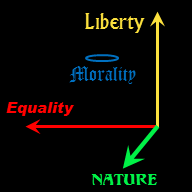
This is a call for a great deal of equality within the Christian ranks. But this is a call for vertical equality, not horizontal equality. Different people have different roles. St. Paul explained this using the human body as a metaphor:
Romans 12:
4 For just as in one body we have many members, and not all the members serve the same function,
5 so we who are many are one body in Christ, and individually we are members who belong to one another.
6 And we have different gifts according to the grace given to us. If the gift is prophecy, that individual must use it in proportion to his faith.
7 If it is service, he must serve; if it is teaching, he must teach;
8 if it is exhortation, he must exhort; if it is contributing, he must do so with sincerity; if it is leadership, he must do so with diligence; if it is showing mercy, he must do so with cheerfulness.
(NET Bible®)
1 Corinthians 12:
27 Now you are Christ's body, and each of you is a member of it.
28 And God has placed in the church first apostles, second prophets, third teachers, then miracles, gifts of healing, helps, gifts of leadership, different kinds of tongues.
29 Not all are apostles, are they? Not all are prophets, are they? Not all are teachers, are they? Not all perform miracles, do they?
30 Not all have gifts of healing, do they? Not all speak in tongues, do they? Not all interpret, do they?
31 But you should be eager for the greater gifts.
And now I will show you a way that is beyond comparison.
(NET Bible®)
In two separate places St. Paul indicates that the running of the Church should be divided up. There is no priest or minister who runs the entire show. There are leaders (governments in the King James), but leadership is rather far down the list of spiritual gifts.
Think of the nerds and absent minded professors you know. The mental abilities that make for a good scholar or college teacher are often separate from good social or administrative skills. The person who is good for officiating your wedding or comforting your dying grandmother is not necessarily good at explaining the Bible, admonishing sinners, or running an organization. Likewise, the skills needed to do outreach/evangelism are separate: college teachers are often introverts; evangelism is often the work of extroverts. Note how Paul separates teaching from exhortation; motivation can be a separate skill from teaching.
Have you ever been subject at church to the verbal equivalent of home movies week after week? Perhaps you had a pastor who was gifted with people skills but not with the gift of teaching.
The Church would be far stronger by dividing up the roles as St. Paul described. But note that there should be division even within each function. Even the best scholar/teacher of the Bible is subject to error. Jesus warned against this. All people are fallible.
Consider the descriptions of the synagogues and the Temple during New Testament times. Jesus and the apostles frequently preached in these venues. Imagine trying to do the equivalent today. How many churches would allow a complete stranger from out of town to take the floor and give a sermon? The closest modern arrangements I can think of are the Quaker churches.
But note also how these sermons did not go unquestioned. Members of the synagogues frequently argued with Jesus and the apostles. How many modern Christian churches allow members to argue with the preacher as part of the service? Suppose modern Christian services were to go back to this model?
- Sermon time would be far more mentally stimulating.*
- The speaker would no longer be the authority; the word of God would be.
The second point is crucial! Throughout Christian history, serious errors have been made because people followed human leaders instead of the Bible. And Jesus warned of this repeatedly.
*Some care must be taken here, however. Debate can turn into argument, creating divisions [2 Timothy 2:22-26]. And even when harmonious debate is mastered, there is the temptation to dwell on obscure points – edge conditions in the Law, cryptic prophesies, or even Bible codes – while neglecting the important basics of the Christian Way [1 Timothy 1:4-8, Titus 3:8-11]. That said, I think these dangers are less than the dangers that arrive when intellectuals are bored to the point of leaving or when debate is squashed by following earthly leaders instead of the world of God.