
87 Ways to Fight Global Warming
There are many, many, ways to fight global warming. Some of them are truly useful. Others are merely symbolic or downright silly. And there are some proposed global warming solutions that are counterproductive or downright evil.
There is an important lesson here. Learn it, and you will be far more effective at fighting climate change.
Below, you will find a honking big list of solutions for global warming. Some of them have real teeth. Some are easy; some are expensive; some require serious tinkering; some require changing the laws of the land. But I have mixed in some simplistic, symbolic, silly and downright evil solutions. Can you tell the difference? Give it a try. When you are done, I’ll reveal the important lesson.
Use Less Fossil Fuels for Heating
- Dress nice during the cold months. The wool suit had a purpose: it gets chilly in Northern Europe.
- Wear long underwear. A bit scratchy, but you can knock the heat down considerably. Going outside is more comfortable too.
- Heat only those rooms that are in use. Radiators or baseboard heating is probably better than ductwork for this trick.
- Use closed cell insulation. Fiberglass has the rated R value if and only if there is no airflow. Foam is more effective, but watch out for the fire hazard!
- Add a drop ceiling during the winter. Go for that Soviet Apartment Look. Lower the ceiling down to doorway height.
- Add solar (heat) collectors to your southern walls. Can be as simple as some clear plastic, some dark material to absorb the light, and some holes to get a convection current going. Dig around in back issues of Mother Earth News for the plans.
- Cover part of your south yard with aluminum foil. Your lawn is dead during the winter anyway. Bounce that sunlight into your south-facing windows and walls. Just don’t stare at the glare.
- Add solar (heat) collectors to your roof. Obvious.
- Live in a smaller home. Less to heat, but surface area to floor space goes up as you shrink.
- Live in a small apartment. High floor space to surface area ratio and yet low floor space!
Save Energy on Air Conditioning
- Ditch the coat and tie during the warm months. Let’s have Casual August instead of Casual Friday.
- Wear shorts in the summer. Works for me.
- Vent office equipment directly outside. With sufficient airflow, computers and copiers are quite happy with 100 degree air.
- Sweat.
- Place reflective aluminum barrier in front of southern wall. It could be the same aluminum used to reflect light to the house in the winter.
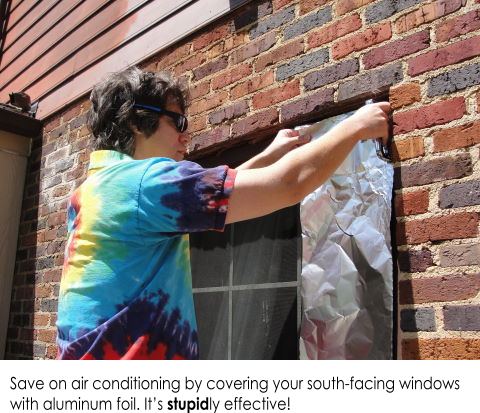
- Cover your southern windows with aluminum foil during the day. Even more effective. And ugly!
More Efficient Refrigeration
- Put the hot coils and compressor outside. No point warming up the house in summer, and you can make use of the cold in winter. Cuts down interior noise as well.
- Use separate coolant circuits for freezer and refrigerator. Efficiency is a function of temperature difference. It’s more efficient to use cool coils to chill the refrigerator than to use the freezer’s circuit. (I’ll run the numbers one of these days...)
Cooking with Less Energy
- Put a lid on your pans. The heat of evaporation to keep water boiling is quite high.
- Use a small oven for small dishes. This assumes that the small oven has reasonable insulation. A cheap toaster oven might not scale down as much as the size indicates.
- Use a convection oven. A little fan puts more heat on the food.
- Use a solar oven. Remember to wear shades. Going blind is not fun.
- Cook using biomass. Why waste those grass clippings and leaves? Could be an air pollution problem in high density areas.
- Eat more raw food. You will absorb fewer calories and take more time chewing, but Americans are too fat anyway.
Hot Water Savings
- Use a front loading washing machine. Keep your kids out of that all too accessible front door!
- Wash clothes in cold water.
- Be a dirty hippy and don’t bother washing your clothes so often. Patchouli, anyone?
- Put a bucket in your bathtub and fill it instead of the tub. Wash with sponge; rinse with smaller bucket. Way back before running water they had tubs which looked like a big metal clamshell with a basin in the bottom and a seat. You sat on the seat, dipped in the basin and the clamshell caught the dripping water.
- Take cold baths. Some people even claim it is good for you. Tim Ferris even adds ice in order to make himself sleep better.
- Install a solar hot water heater.
- Heat with biomass. (Wood, corn cobs, etc.)
- Heat water with waste heat from diesel generator. In theory, you can bring up overall efficiency to close to 100%! Engine inefficiency = waste heat.
- Heat water with waste heat from Sterling cycle generator. Quieter, and can run on any source of heat in theory: gas, oil, leaves, wood, etc.
- Bathe only once per year, Tudor style.
Save Energy on Lighting
- Use windows for light during the day.
- Go to sleep at night.
- Add skylights to single floor block stores and strip malls. Some Walmarts are doing this now.
- Use low power LED lights in the evening. Go for the colored lights with no blue and you might sleep better at night.
- Use LED lights for home outdoor lighting if needed. Once again, blue free can help you sleep and doesn’t attract bugs.
- Have cities use lower power outdoor lights. This might require some crime control measures as a prerequisite. For example we could fix the welfare system, end the drug war, and demand compensation instead of soul-hardening prison time for property criminals.
- Use waste vegetable oil powered lamps. If you are lucky you might encounter a genie!
Reduce Energy used by Electronics and Electrical Appliances
- Use flash memory and battery powered clocks instead of main power supply to preserve state and track time when turned off. This would greatly improve appliances such as VCRs and microwave ovens which require reprogramming after a power outage.
- Put battery backup on the DC side of electronics to eliminate an inverter. For example, instead of plugging your computer into an uninterruptible power supply (UPS) you could have a battery inside which draws and resupplies the computer’s own power supply. This could be done for audio amps as well, smoothing the power and reducing the size of the capacitors.
- Adopt a new standard for DC home wiring, with multiple voltages to eliminate the need for power blocks. Outside of your vacuum cleaner and hair dryer, which household appliances outside the kitchen and laundry room need AC power anyway?
- Use a towel for drying hair. Better for the hair.
- Dry clothes using a clothesline. It wasn’t that long ago that upper middle class people had clotheslines in their yards. And in the winter, dry indoor air does the trick.
- Use a Rainbow vacuum cleaner. They are overpriced. But they use less power since the motor doesn’t have to suck air through paper filters.
- Turn off your router at night. Routers and cable modems use a fair amount of electricity.
Reduce Gasoline Used for Commuting
- Ride a motorcycle to work.
- Ride a single seat automobile to work. Think Indy car tamed down a bit for road use.
- Live closer to work. I’m starting a Restore the Cities series, which will be about making the core cities cheaper and more pleasant, so people won’t be so tempted to commute in from distant suburbs.
- Ride a bike.
- Telecommute.
- Take public transport. But how do you get other people to do it?
More Efficient Local Transportation
- Lay out suburbs as old fashioned grids of narrow streets so people can safely walk and ride bikes. (Once again, a major subject I hope to cover later.)
- Haul the kids around in a low power “horseless carriage.” You don’t need the ability to cruise at 70mph to toodle around town. A vehicle with a top speed of 45mph would require a much smaller engine and could be considerably lighter.
- City dwellers could have even lower power horseless carriages, possibly electric or propane powered for reducing air pollution.
- Equip cities with stackable mini cars for rent, with large racks near public transport stations and smaller racks in alleyways. This would make public transport much more attractive as the last mile becomes flexible.
Long Distance Transportation
- Import less stuff. Go isolationist.
- Eat local foods. Rumor has it that fresher foods have more nutrients. They definitely have more taste. Alas, I like mangos and coconuts! Do I have to move to the tropics?
- Revamp passenger trains. I may have more on this subject in the future.
- Hold more business meetings virtually.
- Build carbon fiber supercars. See Rocky Mountain Institute’s ’s web site.
- Use full sized station wagons instead of SUVs for hauling the family. Surprise! This requires repeal of the Corporate Average Fuel Economy standards.
- Genetically engineer a super bug that splits cellulose into sugar to ferment into ethanol. Then develop alternatives for wood, paper and natural fiber clothing after the superbug escapes. See The Nude Bomb.
- Ferment old donuts and other wasted sugars and starches in mini alcohol refineries. See Alcohol, it can be a Gas.
- Grow cattails in sewer effluent and ferment the resulting starch. Once again see Alcohol, it Can Be a Gas
- Make synthetic fuels from biomass using old Nazi technology. Fischer-Tropsch synthesis can work with charcoal just as well as for coal/coke.
- Run cars directly from wood (charcoal) using the water gas process. My grandfather had purchased plans for such a contraption during World War II. Imagine a pulling a small trailer behind your car containing a tank of smoldering charcoal. Wouldn’t work so well with modern fuel injected engines, but we know how to make the old kind...
General Lifestyle
- Don’t have kids.
- Buy less stuff.
- Don’t vacate, meditate! See Jeremy Rifkin’s Entropy or other good life hating works.
- Have a nuclear war focusing on population centers. Fewer people = less energy use, and the resulting “nuclear winter” can offset the greenhouse gases.
Alternative Energy Ideas
- Spend a gazillion dollars on fusion research and cross our fingers.
- Revive conventional nuclear power. Let’s thaw out Walt Disney and let him show us the way.
- Spend a couple of billion developing liquid Thorium breeder reactors. This looks real promising, but I’m not entirely sold. Proliferation issues still concern me. Any nuclear engineers in the audience? Please contact me.
- Deploy solar thermal now. Might be a good solution for unstable desert nations which cannot be trusted with nuclear power.
- Deploy current generation of solar photovoltaics now. Expensive, but if time is truly pressing...
- Uglify the landscape with giant windmills and immense transmission towers to get the power from the windy areas to the cities. Republicans take note: it annoys the Kennedys.
- Spend gobs of money on future research on the next generation of photovoltaics. And hope we get something cheap enough to compete with conventional power before it is too late.
- Spend even more and hope you get something efficient enough that we can power the grid with rooftop solar only. No ugly solar power stations.
- Spend on basic research to [try to] come up with cheap batteries so we don’t need other power sources at night to keep the grid running. I have a few ideas myself on these lines. I just need a research budget…
- Spend even more to [try to] come up with a lightweight and cheap battery for cars and trucks.
Carbon Sequestration
- Stop recycling. Bury paper in the ground.
- Fertilize barren parts of the ocean with iron filings and whatever other nutrients are missing. Could improve the world’s fish catch.
- Stir up nutrients from the sea bottom using Ocean Thermal Energy Conversion. Think giant refrigerator in reverse, using the thermal gradient of the equatorial ocean as an energy source. If you pump cold water from below for the cold side, you also pump up nutrients which have settled.
- Stir up nutrients from the sea bottom using wave power. Less cool, but less problems with barnacles on the heat exchangers.
The Lesson for Climate Activists
If you act on and promote on the tiny symbolic solutions, you can feel good and find out who is on your side – without accomplishing anything substantial. Oops!
If you promote expensive, ineffective and/or downright evil solutions, then climate skeptics gain more reason to go into denial. Those with mere doubt will dig in their heels and claim that climate change is a conspiracy. It’s already happening.
If you want to make progress, focus on the solutions which have the biggest bang per buck. Some of the solutions above have negative net cost. That is, they have value even if dangerous global warming is still two centuries in the future. Some of these solutions can be implemented at a profit, right now.
But other solutions do have a cost. Which are worth the cost? How do we determine which solutions have the best environmental impact per inconvenience to humans?
That is the subject of the next chapter.